Friday, June 28, 2019

3. The Bema calls us to persuade others (2 Cor. 5:10-11)

This is the Temple of Athena Nike that I took at sunset during the supper
on the first night we arrived in Greece. It was within eyesight as Paul preached at "Mars Hill"


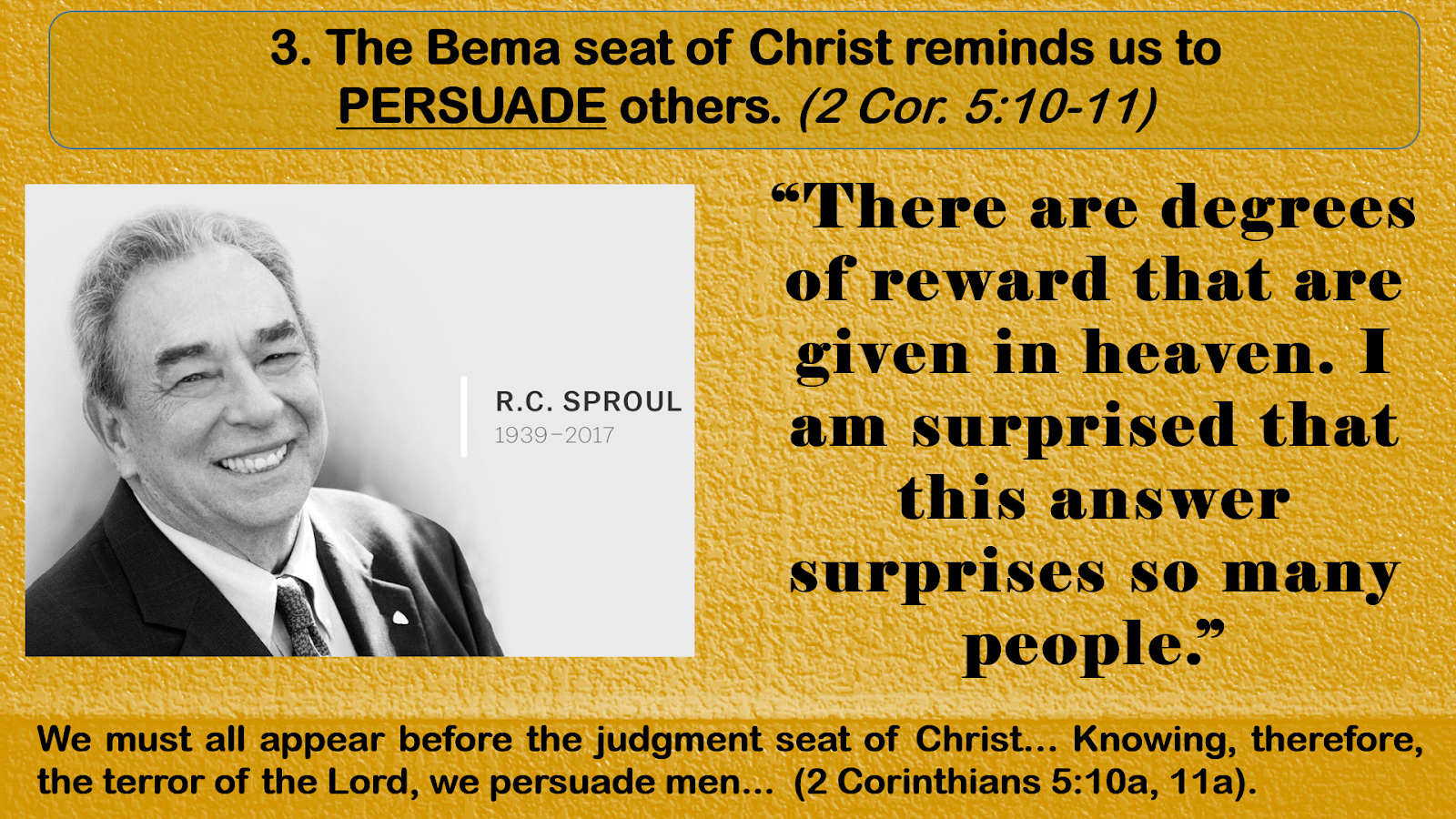
The Bema seat of Christ reminds us to (1) prepare ourselves, to (2) prioritize our good works, and (3) we are to persuade others.
Turn to 2 Corinthians. 5:10-11
10 For we must all appear before the judgment seat of Christ, that each one may receive the things done in the body, according to what he has done, whether good or bad. 11 Knowing, therefore, the terror of the Lord, we persuade men; but we are well known to God, and I also trust are well known in your consciences.
You may wonder why it says “Since, then, we know what it is to fear the Lord, we try to persuade others.” NIV. You may ask, “Why should the terror of the Lord cause us to persuade others?” 
First, I think in some respects we should be afraid of not doing enough works to please the Lord and earn rewards in heaven. Imagine, forever in eternity and a recurring question could be "what did you do for eternity?" What would your response be?

   I believe it would be a fearful thing to say, "I was saved and I did a few kind things, but they did not impact eternity." When our works are tested by the fire of eternity, what will last, and what will be burned. 

   Bob Hartman wrote the following about the Bema.


When from our labor, we retire
There will be a trial by fire.
Will your treasure pass the test?
Or will it burn up with the rest?
You may build upon a sure foundation
With your "building" in dilapidation;
When it all come down in rubble
Will it be wood, hay, or stubble?
Or precious stones -- gold and silver --
Are you really sure?

Every talent will be surely counted,
Every word will have to be accounted.
Not a story will be left untold;
We will stand watch the truth unfold.
Every score will be evened;
Nothing will be left to defend

Every building will be shaken
Every motive will be tried.
He'll give reward to the faithful;
Will you receive or be denied?

And we all will stand at the Bema Seat
All will be revealed - it will be complete
Will there be reward in the fiery heat
When we see our lives at the Bema Seat?

Quotes about rewards in heaven.


   But I think there is another reason why Paul says that we should think about the fear of the Lord or even as NKJV translates it as “the terror of the Lord.”
   The only two judgments there are in the afterlife is the judgment of the living and the judgment of the dead.
   The Living are those who are saved, and notice that Paul says “We MUST ALL appear before the judgment seat of Christ.” And in Rom. 14:10 that "we SHALL ALL stand before the judgment seat of Christ." 
   If we do not persuade those who are lost to stand before the judgment seat of Christ, they will stand before another seat that is described in Revelation 20. 
  A couple of weeks ago, I just mentioned the book of Revelation and someone said, “Oh, I don't read Revelation. That’s a scary book.” It’s not, if you are saved. It’s not, if you are among the spiritually "living"; that is, if your name is in the Book of Life. It is only a scary book, a terror-filled book, a book to lead to fear, IF you are among the "rest of the dead." Jesus called this in John 5:29 "the resurrection of condemnation."
   There are plenty of references that there is going to be a judgment of the living (those who are in Christ, born again) and those who are dead (those whose names are not written in the book of Life). Paul, Peter, John, and even in the Old Testament, Daniel wrote about two judgments. In Daniel 12:2-3, the prophet stated that "some who sleep in the dust of the earth will awake to eternal life, and others will awake to disgrace and eternal contempt."

The Bema steps at Berea, Greece (steps at the center of the photo)

   Peter also wrote about the judgments of the living and of the dead. 1 Peter 4:5-6, “5 They will give an account to Him who is ready to judge the living and the dead. 6 For this reason the gospel was preached also to those who are dead, that they might be judged according to men in the flesh, but live according to God in the spirit.”
   If you are too afraid to turn to Revelation in your own Bible, look below about the second judgment, the Great White Throne Judgment, which is reserved for the dead, those who are not saved. The Great White Throne judgment will come 1,000 years after the Bema seat judgment. John wrote:
    5 But the rest of the dead did not live again until the thousand years were finished. This is the first resurrection. 6 Blessed and holy is he who has part in the first resurrection. Over such the second death has no power, but they shall be priests of God and of Christ, and shall reign with Him a thousand years.
 7  Now when the thousand years have expired, Satan will be released from his prison 8 and will go out to deceive the nations which are in the four corners of the earth, Gog and Magog, to gather them together to battle, whose number is as the sand of the sea. 9 They went up on the breadth of the earth and surrounded the camp of the saints and the beloved city. And fire came down from God out of heaven and devoured them.  10 The devil, who deceived them, was cast into the lake of fire and brimstone where the beast and the false prophet are. And they will be tormented day and night forever and ever.
 11 Then I saw a great white throne and Him who sat on it, from whose face the earth and the heaven fled away. And there was found no place for them.  12 And I saw the dead, small and great, standing before God, and books were opened. And another book was opened, which is the Book of Life. And the dead were judged according to their works, by the things which were written in the books. 13 The sea gave up the dead who were in it, and Death and Hades delivered up the dead who were in them. And they were judged, each one according to his works. 14 Then Death and Hades were cast into the lake of fire. This is the second death. 15 And anyone not found written in the Book of Life was cast into the lake of fire.
Revelation 20:5-11
Let those words sink in for a moment. If you think life is scary, death without a good God is absolutely terrifying.
The cave which is thought to be where John received and wrote the final chapter of the Bible.
Note the three-fold rocks overhead, bringing to mind a symbolism of the Trinity. 

   Paul knew about the two judgments. He said that knowing the terror of the second judgment should make us persuade people to be a part of the first resurrection and the Bema Judgment.
   In 2 Timothy 4:1, Paul's final epistle, he writes that Jesus will judge believers, the living, at His appearing on the Bema seat to reward us according to our works; and, He will later judge the unbelievers, the dead, at His kingdom, where Christ will sit on a Great White Throne.
I charge you therefore before God and the Lord Jesus Christ, who will judge the living at His appearing and the dead at His kingdom.
   2 Corinthians 5 ends with Paul's impassioned plea for those in Corinth to also passionately plea to others. Christ reconciled us, Paul says, and now it is Paul's job to reconcile those who are Corinth so that they can reconcile others. 
   As I conclude, I show two photos Melissa took of me, one from the Acropolis, the "high city", with the Areopagus, or "Mars Hill", in the background. The second photo is of me standing on the Bema in Corinth. 
Mars Hill in the background at the foot of the Temple of Athena in Athens
The Bema in Corinth

   Imagine the fears Paul overcame to share in this strange new world of Athens and Corinth. We think of Paul as a superhero, but he was a man, beaten, threatened, and suffered from "conflicts on the outside and fears on the inside," (2 Cor. 7:5). 

  And yet, the oldest denominations in Christianity are the Greek Orthodox and the Roman Catholic churches. Greece was where he lived so long and Rome was where he died. But despite the fears within, he persuaded others with the Lord's help.  He was able to face down his fears, so that others would not have to face the fear of the Lord.

   With the Lord's help, whom can we persuade?


Wednesday, June 26, 2019

2. The Bema leads us to Prioritize our work wisely (1 Cor. 3:11-15)


A depiction of John above the entrance to the monastery at Patmos.
What was his reward for living a martyr's life?
Jesus said his being faithful to death would earn him a crown of life (Rev. 2:10). 

The BEMA steps leading to the Judgment seat of Christ encourages us to PRIORITIZE wisely.

In 1 Cor. 3: 11-15, it says this, “11 For no other foundation can anyone lay than that which is laid, which is Jesus Christ. 12 Now if anyone builds on this foundation with gold, silver, precious stones, wood, hay, straw, 13 each one’s work will become clear; for the Day will declare it, because it will be revealed by fire; and the fire will test each one’s work, of what sort it is. 14 If anyone’s work which he has built on it endures, he will receive a reward. 15 If anyone’s work is burned, he will suffer loss; but he himself will be saved, yet so as through fire.”

    Even though we who are Christians will someday be brought before Christ to be judged according to our works, it is not for our salvation. Look at what this passage says in verse 11, “No other foundation can be laid than was already laid by Jesus Christ.”

    Christ and Christ alone is the only One who can save. So then, what would be the purpose of judgment? It is not for condemnation. Romans 8:1 says, “There is therefore now no condemnation for those who are in Christ Jesus.” Later, in Romans 8:38, the Bible says that nothing can separate us from the love of Christ.

    Jesus used a gentler word in John 5:24, which is sometimes translated as "condemnation," but is mostly translated as "judgment". “Most assuredly, I say to you, he who hears My word and believes in Him who sent Me has everlasting life, and shall not come into judgment, but has passed from death into life.”

    It is not for eternal damnation nor judgment in the sense of punishment that we will face at the Bema Seat Judgment of Christ. We who have eternal life will have it for eternity and actually we have had it from eternity. Let’s think about that for a moment.

    Did God know before you accepted Christ that you would do so? He is, after all, God, so does He not know all things, being omniscient (a theological word meaning all knowing)? Let us think about what happened before Genesis 1:1, before the foundation of the world or “cosmos” occurred.

    John 17:24, Jesus said that God loved Jesus before the foundation of the world. The Greek the word for world is cosmos, and could be considered as universe. Ephesians 1:4 says that God chose you before the foundation of the cosmos. That being the case, notice that in Revelation 17:8, the Bible says that “those who dwell on the earth will marvel, whose names are not written in the Book of Life from the foundation of the world.” Not only did God choose us before the universe began, but he also had a Book of Life with names NOT written in it from the foundation of the world.

Hmm.

    Furthermore, Matthew 25:34 says a kingdom was prepared “for you, from the foundation of the world.”

    There are two resurrections, the resurrection of the “living” and the resurrection of the “dead”. Those of us who have eternal life will die physically, but will be raised. Those who are unsaved, will also die physically but will be resurrected to be judged for eternal judgment.

    Christians will be judged “according to” their works, but not “for” their works. Our foundation was laid by Jesus and will last for eternity. Don't you think that the things we are building upon that eternal foundation should also last for eternity and not be burned up? Of course they should.

    There will be some who have worked hard to amass a fortune in this life, but will have nothing to show for eternity. God’s going to judge how many times you won at computer solitaire, and then show you how you neglected your family, neglected your neighbors. 

    Christ is going to show you that all of that cheering and shouting at the television didn’t help your team win one little bit, but your silence in sharing the gospel will be deafening to those with whom you did not share.

The Bema Seat at Corinth, where Paul was brought before Gallio in 50 A.D.
Paul would write twice about the Bema Seat to the Corinthians (1 Cor. 3 and 2 Cor. 5)
At Christ's Bema Seat, we will be judged for our works before a Righteous Judge 

    You may feel great about clothing the naked, feeding the hungry, housing the homeless and those are all good and noble things, but it may be burned up under the fiery eyes of Christ’s judgment at the Bema seat, if it fed them for a day but did not lead them to the most important thing: eternal life.

    Several years ago, the former Mayor of New York Michael Bloomberg said the following in a New York Times article the following:
“I am telling you if there is a God, when I get to heaven I’m not stopping to be interviewed. I am heading straight in. I have earned my place in heaven. It’s not even close.”
    What will be his good works? Bloomberg told the Times that he spent $50 million to push gun control, that he took on issues to fight obesity and smoking and because of that and other accomplishments, he believes he’s earned a spot in heaven.

    Our salvation is determined by God, specifically by the foundation laid by Christ by His death, burial and resurrection. But our works are determined by us, and we will be judged “according to our works.” God has prepared you for good works (Eph. 2:10), but it is up to you do choose to walk in those good works. It is up to us to build on the foundation of Christ with things that will last for eternity.

    What will be our reward? I like what the Apostle Paul says, “For what is our hope, or joy, or crown of rejoicing? Is it not even you in the presence of our Lord Jesus Christ at His coming?” (1 Thess. 2:19). A soul led to the Lord and His salvation by your witness will be a hope, joy and crown of rejoicing that will last for all eternity. Paul again says that those in Philippi were his crown (Phil. 4:1).

An inscription showing the remnants of the church at Philippi.
Even though the church is gone, Paul wrorte that 

the church was his crown that would withstand the Bema test of fire. 
   There are imperishable crowns, 1 Cor. 9:25 says. Loving and longing for Christ’s appearance is a crown of righteousness, 2 Tim. 4:8 says. Remember when 2 Timothy was written: while Paul was languishing in a prison, deserted and forsaken by so many, awaiting his beheading by Nero. Paul was faithful to the end and he could have forsaken it all, but held to his righteous good works and for his efforts would receive a crown of righteousness.

   Paul was not the only one seeking a crown: James said that loving Christ will earn the crown of life (James 1:12). Peter said that good shepherds, pastors yes, but anyone who watches over others in the flock, would receive the crown of glory that never fades (1 Peter 5:2-4). John was told by a good Authority, Jesus Himself on the island of Patmos, that those who were faithful unto death, martyrs perhaps, would receive the crown of life (Rev. 2:10).

   What are you working for? Work for the One who brings His reward with Him for you. “And behold, I am coming quickly, and My reward is with Me, to give to every one according to his work” (Rev. 22:12).


Tuesday, June 25, 2019

1. The Bema leads us to prepare ourselves b. in Unity (Rom. 14:12-13, 16-17) and c. Charity (Rom. 14:15)

A Mosaic commemorating the Bema  likely used by
the Apostle Paul at the Berea synogogue around 50 A.D.

In the previous post, we saw that the Bema Judgment seat of Christ reminds us to prepare ourselves. First we should not mettle in matters that don’t matter. Instead, have liberty.
b.     Secondly we should not judgmentally disdain others or have contempt for others. Instead, have unity. (Rom. 14:12-13)


   If you look again in Romans 14:12-13, You will see that we should not disdain or have contempt or hurt other believers. 
 12 So then each of us shall give account of himself to God. 13 Therefore let us not judge one another anymore, but rather resolve this, not to put a stumbling block or a cause to fall in our brother’s way.”
   It is clear that Paul is talking about brothers and sisters in Christ only who will stand before Christ’s BEMA, giving an account not of what others have done or what others haven’t done, but what we have done and why we have done them. 
   The Bema seat calls us to prepare ourselves by seeking Christ, by following Christ, by obeying Christ, by loving Christ and loving others whom he has saved. There are certain things that we have to agree on as the essentials.

   1) The Bible is literally true. If you start to pick and choose what to believe and not believe about what the Bible clearly teaches, then we cannot have unity.  How else would we know what Christ taught if it were not for the inspired, inerrant, infallible Word of God. If we agree that the Bible is true, that really takes care of the following, but let's see what else unifies us in Christ and keeps us together.


   2) The deity of Christ. If Jesus was not God, then his death, however noble, would be the death of another mere mortal man. From the beginning, we see that Christ was "God with us" or Emmanuel, the name of Christ as first announced in Matthew 1:23. If anyone does not agree that Christ was and is God incarnate, there really is no unity.


   3) The Christ is the only way of salvation, and that there is no other way to heaven. This too was from the beginning, as seen in Matthew 1:21:


“And she will bring forth a Son, and you shall call His name JESUS, for He will save His people from their sins.”
   Jesus even prayed in the Garden of Gethsemane that if there was any other way, to let the cup of death pass, but God's will was done and Christ was crucified. 

   This is the gospel and Paul said if anyone preaches a different gospel, he and his message is to be accursed (see Galatians 1). 

   The early disciples said in Acts 4:12 that there is no other name by which we can be saved. 

   Acts 10:42-43 says that Christ will judge the living (Christians at the Bema Seat) and the dead (the unsaved at the Great White Throne Judgment Seat).


42 And He commanded us to preach to the people, and to testify that it is He who was ordained by God to be Judge of the living and the dead43 To Him all the prophets witness that, through His name, whoever believes in Him will receive remission of sins. 

   4) The bodily resurrection of Jesus is not debatable among true Christians. If anyone does not believe that Christ was literally risen from the dead, we cannot have unity. Paul explains the gospel as simply as possible in 1 Corinthians 15:3-7 and then says the following in verses 13-19.

 13 But if there is no resurrection of the dead, then Christ is not risen. 14 And if Christ is not risen, then our preaching is empty and your faith is also empty. 15 Yes, and we are found false witnesses of God, because we have testified of God that He raised up Christ, whom He did not raise up—if in fact the dead do not rise. 16 For if the dead do not rise, then Christ is not risen. 17 And if Christ is not risen, your faith is futile; you are still in your sins! 18 Then also those who have fallen asleep in Christ have perished. 19 If in this life only we have hope in Christ, we are of all men the most pitiable.
  So while we are not to judge others in the non-essential matters that don't matter, there are some matters that do matter. There are more "essentials" of unity than the four above, but we will go forward from here. 

    In Romans 14:4, just above that, look, “Who are you to judge another’s servant? To his own master he stands or falls. Indeed, he will be made to stand, for God is able to make him stand.” 

    Now before you applaud that and shout amen, the point is that God through Christ will judge you and Christ will judge me. He will not judge by what is politically correct or what the 21st century American society says.

    NO. 

    He will judge us by the same standard: the inspired, infallible, inerrant, unchanging, never fading, ever-living and ever-convicting word of God, the Bible.
    The BEMA seat of Christ reminds us to prepare ourselves to stand before God by faith in Jesus alone, but we will be judged by Christ according to our works for our rewards. Therefore we should have liberty and have unity.
c.     Don’t judgmentally destroy others who are weaker because you consider yourself spiritually superior. Instead, have charity. (Rom. 14:15)


    My favorite Billy Graham quote came to me after his death. 
It is God’s place to judge,
it is the Holy Spirit’s place to convict,
and it is our place to love. 
    We should prepare ourselves in liberty, we should prepare ourselves in unity and the Bema Judgment of Christ should prepare ourselves in charity. By Charity I mean “In love.” 

     Again in your Bibles, Romans 14 of is likely divided into two parts, the Law of Liberty and the Law of Love. My three subpoints that we need to prepare ourselves is an homage to a quote attributed to St. Augustine, “In essentials, unity; in non-essentials, liberty, in all things, charity.           
    Notice what Jesus said in Luke 6:35. Luke 6:35 says, “But love your enemies, do good, and lend, hoping for nothing in return; and your reward will be great, and you will be sons of the Most High. For He is kind to the unthankful and evil.” If Jesus said we are to love our enemies for our reward, that even God is kind to the unthankful and evil, how much more should we love those fellow believers who are weak, who may stumble by our liberty and lack of unity.

Tomorrow we will see how to prioritize our "building" materials of our works wisely.

Monday, June 24, 2019

1a. The Bema leads us to prepare ourselves a. in Liberty (Rom. 14:4)


    What is the Bema Judgment Seat? In the Greek translation of the Old Testament, the "bema" was the wooden pulpit on which Nehemiah stood from morning to midday when he read the Scriptures to the Hebrew people. 
    In Rome, it was the platform on which the judge of the games would sit not only to oversee the start and finish of a race but also to award the prize to the victor (anyone ever see Ben-Hur?)
    In Jerusalem, when Pontius Pilate sat down, the Greek word bema was used in both Matthew and John to refer to location of his rendering of the verdict against Christ.
   In Corinth, Paul was brought before Gallio at the bema. See video
   In Philippi, Paul was beaten before the bema.
   And in Veria (called Berea in the Bible), there are bema steps that led to the synagogue. If you have ever heard of a Berean Church, it is named in honor of the people of this city who were more noble than those who were in Thessalonica as they consulted with the Scriptures daily to see if what Paul and Silas was preaching was true. See video
   In Caesarea, Festus sat on the bema seat as Paul made his arguments for Christ. Upon a bema seat, judgments were rendered, and exonerations were granted.
    So, if Christ was judged at a bema seat,
       if Paul was unfairly punished at a bema seat,
        if Gallio and Festus and others unfairly rendered unjust verdicts 
against Paul,
  against Jason, a believer in Thessalonica,
    against Sosthenes in Corinth,

 then why would Paul use this term to refer to the judgment seat of Christ for Christians?
   It is because there is coming a day in which the true and righteous and holy God will bring all of us who go by the name of Christ, who are believers who are true saved by grace through faith Christians, God will bring us before the bema steps of Christ and call us to give an account of what we have done here on earth with that saving faith. God will call us to see our works both good and bad and be judged according to them. 
1. The bema seat of Christ reminds us to prepare ourselves. Romans 14:9-11
  9 For to this end Christ died and rose and lived again, that He might be Lord of both the dead and the living.  10But why do you judge your brother? Or why do you show contempt for your brother? For we shall all stand before the bema, the tribune, the judgment seat of Christ. 11 For it is written: ​​“As I live, says the LORD, ​​ every knee shall bow to Me, and every tongue shall confess to God.”


There are three subpoints to this call to prepare ourselves that we should remember, the first given today and two more to be shared in the next post.
a. Don’t judgmentally mettle in matters that don’t matter. Instead, have liberty. (Romans 14:1). 


    If you were to read this entire passage of Romans 14, beginning in verse 1, you will see that Paul is urging the Roman church to not dispute over questionable things and not to judge brothers and sisters in Christ on issues that are not important,
            that are not a matter of heaven or hell,
                        that are not crucial issues of salvation.
    Romans 14 could be divided in three parts: “The Law of Liberty”, The Law of Lordship”, and The Law of Love”. 
     Look at 14:1. “Receive one who is weak in the faith, but not to disputes over doubtful things.” 
    We as a group of 17 Protestants, spent the week in Greece, home of the Greek Orthodox church, with a tour group of members of the Roman Catholic Church.
     We had a marvelous time and chose not to meddle in matters that didn’t matter, but instead we rejoiced in the things that united us in Christ. We were united under the law of Liberty!
    All Christians will be brought before the bema seat of Christ and He will sort things out. I believe this will happen immediately after the rapture of the church. You may say, “Pastor Tim, why do you think it will be then?” 

    Revelation 22:12 says,  12 “And behold, I am coming quickly, and My reward is with Me, to give to everyone according to his work. 13 I am the Alpha and the Omega, the Beginning and the End, the First and the Last.”
     Notice that Jesus does not say he will reward us because of our work, but according to our work. This is a repeated theme for the bema seat judgment for Christians. Immediately after we are caught up together with Christ, all Christians will be judged according to our works for our rewards, not to determine our eternal resting place in heaven or hell, but to reveal our rewards we will have in heaven. 
    The voice of the angel and the trumpet of God will sound and we who are true believers in the faith will be forever with Christ. Nine times in the Sermon on the Mount of Matthew 5 through 7, Jesus spoke directly about rewards and stated that the faithful and righteous Judge will reward us for our efforts here on earth. That may not be your motivation to do good deeds on earth, but it is marvelous that God will remember and reward our efforts!
    You see, we are saved by faith alone, but saving faith is never alone. Paul said we are saved by grace through faith and not of works, but in verse 10 of Ephesians 2 states that we are the "workmanship of God created in Christ FOR GOOD WORKS." 
We are saved by faith alone, but saving faith is never alone. We will see more about this tomorrow! But for today, let us remember that 
The bema seat of Christ reminds us to prepare ourselves,
and we should not mettle in matters that don’t matter. 
Instead, have LIBERTY.


Monday, May 13, 2019

Building a house -- with wisdom


Parenting is tough stuff. I know in part after raising four kids. And now I see from a distance our sons and daughters-in-law raising my grandchildren.

How do you build a house, a future of adults from the precious gifts of children in the present?

My grandchildren left our house yesterday (sorry Melissa, I keep saying my grandchildren). This morning I opened my Bible to Proverbs 24 and my heart was filled with prayers for our own sons who are now fathers. I prayed for our daughters-in-law who celebrated Mother’s Day yesterday. And a prayed for the future of my grand-kids (oops, I did it again).

“By wisdom, a house is built,” Proverbs 24:3 says, “and through understanding it is established; through knowledge its rooms are filled with rare and beautiful treasures.” Proverbs is filled with wisdom. Ten chapters earlier, Proverbs 14:1 says, “The wise woman builds her house…” and as a rule, women have the greater degree of wisdom in regard to raising a family (and I might add a wise husband would prove his own wisdom by admitting that!). When the book of Proverbs personified wisdom, the writer used the feminine pronoun to embody wisdom (Prov. 3:13-20, 4:7-9).

I find it amusing that the next time wisdom is mentioned in Proverbs 24 is two verses later when the writer is describing battles and war. “The wise prevail through great power and those who have knowledge muster their strength. Surely you need guidance to wage war, and victory is won through many advisers,” Proverbs 24:5-6 says. Undoubtedly, the writer is speaking of actual battles and war, but as I recall the battlefields of life often occur within a home.

So, what is wisdom? What is understanding? How do we acquire knowledge so that the rooms of our homes and more importantly the hearts of our children can “be filled with rare and beautiful treasures”?

Heart wisdom. Wisdom is not just in the mind, but in the heart and in the practice. It is not just the knowledge of what to do, but the desire of doing it and the actual implementation of that wisdom. Many times “wisdom” is translated as a “skill”, a finely honed practice of a craft. Exodus 31:6 reads in the King James this way, “in the hearts of all that are wise hearted I have put wisdom.” If your heart is wise, God will place wisdom, and the ability to carry it out. The New American Standard Bible even translates “wisdom” in this verse as “skill.” “…in the hearts of all who are skillful I have put skill, that they may make all that I have commanded you.”

Life wisdom. Wisdom comes from life experiences and the longer the life, the more experience we have. Job 12:12 says, “Is not wisdom found among the aged? Does not long life bring understanding?” I have found that good judgment comes from experience and experience comes from bad judgment! I have learned more from my mistakes than my successes. Eyes may roll when an older person begins with “Well in my day…” Nevertheless, I will attest that eyes shouldn’t roll, but rather widen with anticipation, and it wouldn’t hurt for ears to listen and hearts to learn from the experiences which life brings. No degree or diploma sounds louder than the school of hard knocks!

Fear brings wisdom. Fear of the Lord is different than earthly fear. My name, Tim, means fear but my full name means “fear of God.” To fear God means to honor God with reverence and respect. I may “fear” the radar gun when held by the highway patrol, not because I respect it or even the officer who holds it, but because I value my pocketbook. But to honor and respect God is to value the good that He brings, in and of Himself. Psalm 111:10 says, “The fear of the LORD is the beginning of wisdom; all who follow his precepts have good understanding. To him belongs eternal praise.”

Humility brings wisdom. Pride brings disgrace, but humility bring wisdom, Proverbs 11:2 says. A wise person seeks wisdom, but a foolish person shuns it. Ecclesiastes 7:19 states that “Wisdom strengthen the wise.” Proverbs 9:9 says, “Instruct the wise, and they will be wiser still.” I quote Scripture because the Word of God is what contains wisdom, not my words.

Correction brings wisdom. Sometimes a verbal warning is enough to bring wisdom, but most of the time, it is the “rod of correction” which gets our utmost attention. Proverbs 29:15-17 says, “A rod and a reprimand impart wisdom, but a child left undisciplined disgraces its mother. When the wicked thrive, so does sin…Discipline your children, and they will give you peace; they will bring you the delights you desire.”

God gives wisdom. Ultimately, it is God who brings wisdom. There are too many verses in the Bible to list that truth, but James 1:5 perhaps says it best. “If any of you lacks wisdom, you should ask God, who gives generously to all without finding fault, and it will be given to you.” Proverbs 2 also says “The Lord gives wisdom.” I ask God for wisdom for myself, for my children, and for my church, for He alone is the perfect house-builder. And I ask for wisdom for MY grand-kids!


Saturday, March 30, 2019

"John One Day" now in book form

Hardcover jacket 
The best places to order are 
1) https://bit.ly/timothyoneday -- Outskirts  10 to 50 % discount
2) https://bit.ly/barnesoneday -- Barnes & Noble list price
3) https://bit.ly/johnoneday -- Amazon, free shipping for prime members but $3 over list price!(?) IDK why.

Preview book at https://johnoneday.blogspot.com/
or 


For years, Christians have told new believers to begin reading the Bible with the gospel of John. But without a good study companion for the new believer, the fourth gospel might be a little overwhelming. Finally, there is now a daily devotional of the beloved gospel with new believers specifically in mind! This "basics for believers" study will inspire and encourage all believers, no matter where they are in their Christian journey.
This seven week journey consists of 98 devotionals which author Timothy McKeown has written (and rewritten) for more than thirty years. And yet, the inspired word of God never grows old.
The gospel of John is the deepest of all of the gospels and perhaps the most contemplative of all of the books in the New Testament. This devotional book is designed for new believers and young disciples to dig deeply into the most reflective of the four gospels. Matthew, Mark, and Luke tell what Jesus did, but the primary concern of John, "the disciple whom Jesus loved," is to tell what Jesus taught--and why. The Beloved Apostle only included a few of the miraculous signs which Jesus performed, but each one is strategically included for one primary purpose: "But these are written that you may believe that Jesus is the Christ, the Son of God, and that believing you may have life in His name." (John 20:31, NKJV)
"From the beginning, my desire has always been for new believers to study this amazing story of Christ on a daily basis, in short devotionals of 500 words or less," explains Pastor Tim McKeown, who began writing these lessons as a young youth pastor in seminary. "I have also put some things in this devotional that I hope will inspire the more mature Christian. My goal is to help new believers grow and for the seasoned believers to grow deeper from this enlightening gospel."
The Bible and especially the gospel of John is as unfathomable as the ocean's depths, where scientists may never cease to explore but also as inviting as the coastal shore, where even the smallest of children may play. The apostle wrote this gospel as the sole surviving apostle, with a purpose as straight and strong as the Master he first met when he was a young fisherman. That purpose was that readers and hearers of the gospel would place their trust squarely in and on the Lord Jesus Christ for their eternal life. John even defines what "eternal life" is by quoting Jesus who prayed in John 17:3, "Now this is eternal life, that they know you, the only true God, and Jesus Christ whom you have sent" (NIV).
If you are ready to grow deeper, to have that eternal life, let us walk together through this gospel journey, one day at a time, and learn the depths of eternal life; that is, knowing God and Jesus Christ. May this devotional book be as much of a blessing to you as the Gospel of John has been to so many over the years.


Monday, March 25, 2019

When God says "No"


     Do you ever want to go one way and the Lord leads you another way? Maybe it’s your background, your environment, even your own limitations that keep you from going the way you want to go. It could even be even sinful experiences either your own, or what others have done against you that thwarts your plans.

    God’s answers of “no” are probably more common in the Bible that God’s answers of “yes”. Perhaps one of the most obvious examples of this is Paul’s second missionary journey. It begins with a “sharp contention” (Acts 15:39) between Paul and Barnabas over whether John Mark is to go with them. Barnabas retraces their first route while Paul journeys the reverse course, to Cilicia, Derbe, Lystra, and Iconium. Their goal was simply to return to the churches they established on the first journey and “see how they were doing” (Acts 15:36).

    Twice the Holy Spirit constrained Paul, Silas and Timothy. First, they were forbidden to preach in Asia. Then, “the Spirit did not permit them” to go to Bithynia (see Acts 16-6-7).

    So, what did Paul do? Did he give up and go home? No. Did he blame others like Barnabas or have self-doubts about his stubborn contention over John Mark? Maybe. Did he keep going until he heard the call of God? Absolutely. “We sought to go to Macedonia, concluding that the Lord had called us to preach the gospel to them” (16:10).

    One of the most common reasons people stop serving the Lord is when God puts what we think are road blocks on our plans. Paul’s original plan appeared to go clockwise like he did on his first journey then circle back to Antioch (Syria). Instead, the Holy Spirit led them not to a dead end, but to a detour from Paul’s plans and a call to the Lord’s plans.

    Like Paul and probably like you, I’ve had the Lord change my plans. God’s changes are not God’s cancellations, but course corrections. The Spirit’s detours are not dead ends, but new, better destinations. Sure there were imprisonments and beatings along the way, but there were also conversions and eventually Paul ended up in at the Areopagus, conferring and convincing the philosophers of Athens.

    God’s delays and detours are not His denials. Keep listening for God’s Macedonian call for your life.