Wednesday, January 13, 2021

Who are the 144,000?


  Revelation 7:

The 144,000 on Earth &

The Innumerable Multitude In Heaven

Revelation 7:1-17

Timothy McKeown

Chapter seven begins the first stated resumption of the relationship of God with the nation of Israel. For 2,000 years, God has dealt with His people through the church, and now He will be relating to His first chosen people with whom He he related for 2,000 years before Christ, ever since the days of Abraham.

We have seen the opening of the first six seals and there is an interlude here before the seventh seal. Nothing in the previous six seals specifically dealt with Israel but here in chapter seven, it is clear that God is indeed working with the nation of Israel and specifically the twelve tribes.


1 After these things I saw four angels standing at the four corners of the earth, holding the four winds of the earth, that the wind should not blow on the earth, on the sea, or on any tree.

It is obvious to us today that this is figurative language. The four corners phrase is symbolic of the “ends of the earth” (distant lands in all directions) as seen in a comparison of two passages from Isaiah.

5 “Do not be afraid, because I am with you. I will bring your descendants from the EAST and gather you from the WEST. 6 I will say to the NORTH, “Give them up,” and to the SOUTH, “Do not keep them.” Bring my sons from far away and my daughters from the ENDS OF THE EARTH.”  (Isaiah 43)

11 It shall come to pass in that day that the Lord shall set His hand again the second time to recover the remnant of His people who are left, from ASSYRIA and EGYPT, from PATHROS and CUSH, From ELAM and SHINAR, from HAMATH and the ISLANDS OF THE SEA. 12 He will set up a banner for the nations, and will assemble the outcasts of Israel, and gather together the dispersed of Judah from the FOUR CORNERS OF THE EARTH.  (Isaiah 11)

Since the four “corners” of the earth are figurative, could it be that the “four winds of the earth” is symbolic as well?

Yes! In the Old Testament, the “four winds” were figurative of armed forces scattering the nation of Elam (Jeremiah 49:35 - 39); of a prophetic breath to bring life into an army in the valley of the dry bones (Ezekiel 37:7 - 10); of four military powers which took the place of the large horn (Daniel 8:8, 11:4); and the various directions that Israel was scattered. Virtually all of the “four winds” symbols from the Old Testament showed military might. Therefore, here in Revelation 7, for the four winds to be held and “should not blow on the earth” likely means that during the Tribulation there will be a time of peace, a calm before the storm, definitely after the tumultuous Rapture and after the opening of the first six seal judgments.

2 Then I saw another angel ascending from the east, having the seal of the living God. And he cried with a loud voice to the four angels to whom it was granted to harm the earth and the sea, 3 saying, “Do not harm the earth, the sea, or the trees till we have sealed the servants of our God on their foreheads.” 4 And I heard the number of those who were sealed. One hundred and forty-four thousand of all the tribes of the children of Israel were sealed:

During this interlude, nothing would hurt the land (earth), the waters (sea) or the plants (trees). This time allows 144,000 Jewish virgin male believers in Christ (see Revelation 14:4) to be sealed on their foreheads. They are called the “firstfruits” unto God, perhaps the very first Jews who will receive salvation after the Rapture and during the Tribulation. The four angels are not only able to withhold harm, they are also granted the power to inflict harm.

But from the east a fifth angel arises, this one with a “seal of the living God.” The seal will mark the 144,000 with redemption, which could mean they were sealed with the Holy Spirit. We too in the church age are also sealed with the Holy Spirit for the Day of Redemption. “Now He who establishes us with you in Christ and has anointed us is God, who also has SEALED us and given us the SPIRIT in our hearts as a guarantee” (2 Corinthians 1:21-22). See also Ephesians 1:13 and 4:30.

Twelve is the number of God’s people, whether in the Old Testament and the twelve tribes, or in the New Testament and the twelve apostles. Twelve times twelve thousand means that God will seal not only the 144,000 but also all of His people whom He will redeem during this Tribulation.

5 of the tribe of Judah twelve thousand were sealed; of the tribe of Reuben twelve thousand were sealed; of the tribe of Gad twelve thousand were sealed; 6 of the tribe of Asher twelve thousand were sealed; of the tribe of Naphtali twelve thousand were sealed; of the tribe of Manasseh twelve thousand were sealed; 7 of the tribe of Simeon twelve thousand were sealed; of the tribe of Levi twelve thousand were sealed; of the tribe of Issachar twelve thousand were sealed; 8 of the tribe of Zebulun twelve thousand were sealed; of the tribe of Joseph twelve thousand were sealed; of the tribe of Benjamin twelve thousand were sealed.

A careful look at the twelve tribes shows that one of Israel’s sons is omitted: Dan. Instead, Manasseh, Joseph’s first-born son, is included. Ephraim, Joseph’s second son and the one upon whom Israel laid his right hand of blessing, is also not mentioned here, but Levi, the priestly tribe which did not have land to possess, is mentioned.

It is likely that Joseph’s name and tribe is synonymous and inclusive of the tribe of Ephraim. It is very possible that the descendants of the tribe of Dan have become totally extinct in the world by the time of the Tribulation. Even though most Jews today do not know for sure what tribe they are from, it appears that God knows and will seal the descendants Himself. Further, it is not stated in Revelation that those who are sealed will know that they are of a particular tribe, but undoubtedly it will be revealed in heaven.

When I first did this study back in 2006, DNA research was not nearly as thorough as it is now. Not only would God know who was of what tribe, but we also can now ascertain from what lineage the Jews would be from.

9 After these things I looked, and behold, a great multitude which no one could number, of all nations, tribes, peoples, and tongues, standing before the throne and before the Lamb, clothed with white robes, with palm branches in their hands, 10 and crying out with a loud voice, saying, “Salvation belongs to our God who sits on the throne, and to the Lamb!” 11 All the angels stood around the throne and the elders and the four living creatures, and fell on their faces before the throne and worshiped God, 12 saying: “Amen! Blessing and glory and wisdom, Thanksgiving and honor and power and might, Be to our God forever and ever. Amen.” 13 Then one of the elders answered, saying to me, “Who are these arrayed in white robes, and where did they come from?” 14 And I said to him, “Sir, you know.” So he said to me, “These are the ones who come out of the great tribulation, and washed their robes and made them white in the blood of the Lamb.

The scene suddenly changes to heaven again, as it did in chapter six. This time, the souls are no longer under the altar, but before the throne and before Christ, now clothed with white robes. In heaven, there will be “a great multitude” (heard again in Revelation 19:1 and 19:6), which cannot be counted.

A false religion erroneously claims that only 144,000 will be in heaven, but here the Bible clearly says that is not true. God knows the number who will be in heaven, but here John refrains from saying, as he did before, “ten thousand times ten thousand and thousands of thousands” (see Revelation 5:11). This does not yet include the 144,000, but these are those who came out of the Great Tribulation.

These in heaven could be those who were saved after the Rapture. They could be those who failed to believe in Christ prior to His glorious appearance, but after their family and friends had vanished from the earth, these who were left behind “washed their robes…in the blood of the Lamb.”

Do you see the parallel to Revelation 3? White garments are promised for those in Sardis, which had those who, if they did not watch, would be overtaken by Christ like a thief (see Revelation 3:3). Numerous professing “believers” may know about Jesus, but they themselves are not known by Christ. Perhaps they will become saved during the Tribulation.

The opening of the sixth seal in chapter six indicates that many know that the “great day of His wrath is come,” and even know that it is the “wrath of the Lamb.” (Revelation 6:16-17). All we know for sure is that there will be a great numberless multitude of people saved from every nation, tribe, people, and tongue during the Great Tribulation.

Palm branches are a symbol of victorious triumph and reminds us of the glorious triumphal entry Christ made on Palm Sunday, when the people shouted out Psalm 118:26, “Blessed is He who comes in the name of the Lord.” See Matthew 21:9, Mark 11:9, and John 12:13. Jesus said that Israel would not see Him again until they themselves shouted that same refrain (Matthew 23:39).

15 Therefore they are before the throne of God and serve Him day and night in His temple. And He who sits on the throne will dwell among them. 16 They shall neither hunger anymore nor thirst anymore; the sun shall not strike them, nor any heat; 17 for the Lamb who is in the midst of the throne will shepherd them and lead them to living fountains of waters. And God will wipe away every tear from their eyes.”

The worship of God is not mandated, it is intrinsic within those who are saved. They are granted no hunger, yet we will be able to eat. We shall never be thirsty, yet we can drink. The sun and its heat will not strike us, but the Lamb will never leave us, and His glory will enlighten us. And the blessed promise comes that God Himself will wipe away every tear, an occurrence which occurs again in Revelation 21:4, in which a promise comes which says crying will never occur again.


Our takeaway from this chapter:

Number one, (pardon the pun), God knows our number! He knows our genealogy; that is, where we came from, He knows where we are, and most of all, He knows where we are going.

Number two, God seals us now with His Holy Spirit, and we will never lose our salvation. Likewise, in the Great Tribulation, God’s servants will be protected until death, and then He will give them the crown of life.

Number three, God will keep His promises. The nation of Israel in Revelation will carry palm leaves to the Lord and recognize Him as the Lamb, they will look on Him whom they themselves pierced (Zechariah 12:10).

Number four, while there will be 144,000 Jewish men on the earth (later in heaven), the number of those who will be saved is going to be HUGE, a number that no human could ascertain. In all of the evil of the Great Tribulation, God brings good and He alone can bring good in the tribulation of your lives today.

Number five, the Shepherd, the Lord, the Lamb, will dwell among us someday.

Number six, Sardis was a church in existence before the Rapture and they were warned to be ready for the Lord who will come like a thief in the night (Matthew 24:43; Luke 12:39; 1 Thessalonians 5:2, 4; 2 Peter 3:10; Revelation 3:3, 16:15).  

Number seven, no more crying there.

Tuesday, January 12, 2021

Revelation 6's fallen star


Revelation 6:

The Final Seal Judgments

Revelation 6:9-17

Timothy McKeown 

The first four seal judgments, or the four horsemen, represent the peaceful world conquest by the antichrist (1st seal), the taking of peace from the earth, killing, and a great sword (2nd seal), the world-wide famine, an inflationary economy, and the world’s wealth is protected (3rd seal), and one-fourth of the world dying from war, starvation, martyrdom, and “beasts” of the earth. 

Note: this is the only place where “beast” (Gr.: therion) is not linked with the antichrist or the false prophet.
Antichrist: 11:7, 13:1-4, 14-15, 17-18, 14:9,11, 15:2, 16:2, 10, 13, 19:19-20; 20:4, 10;
Beast ridden by woman/whore: 17:8, 11-13, 17:3, 7, 11-13, 17:16-17;
False Prophet: 13:11-12. 

It’s possible that this foreshadows the two beasts killing people and especially believers in the Great Tribulation. After the fourth horseman of Death, followed by Hades, comes a scene from heaven.


9 When He opened the fifth seal, I saw under the altar the souls of those who had been slain for the word of God and for the testimony which they held. 10 And they cried with a loud voice, saying, “How long, O Lord, holy and true, until You judge and avenge our blood on those who dwell on the earth?” 11 Then a white robe was given to each of them; and it was said to them that they should rest a little while longer, until both the number of their fellow servants and their brethren, who would be killed as they were, was completed.


The fifth seal depicts those who have been killed for the word of God and the testimony. Isaiah 34:2-3 says that God gave the nations for judgment and describes a stench because of the corpses. John does not list how many are slain, but these are among the first and they reveal at least five truths:
 1) The dead are aware of events on earth and care about justice of those responsible.
 
2) There is a concept of time and are told to wait “a little while longer,” so time in heaven is comparable to time on earth.
  
3) While they have not been resurrected yet (see Revelation 20:4-6), they can receive robes, which they wear in Revelation 7:9.
 
4) Saints cry in anguish, remembering their injustice, but recognizing God as “holy and true.” At some point in the future, God will wipe away their tears (Revelation 7:17, 21:4 with Isaiah 25:8).
 
5) They were killed for word of God and testimony of Jesus (compare to Revelation 20:4, 12:11 and 17, and Revelation 1:9).

Why under the altar? According to John Gill’s Exposition of the Bible, “burning coals were taken off from the altar …and were brought in within the vail (sic), where incense was put upon them, which covered the mercy seat” (See Leviticus 16:12-13). Faithful martyrs are brought into heaven, like the burning coals were brought into the holy of holies, and with the prayers, are a sweet aroma of sacrifice before God (see Revelation 8:3-4).

It may be that this fifth seal is an interlude showing all of those who have been martyred during the Tribulation, and the sixth and seventh seal are at the end of the Tribulation. If so, the trumpet and bowl judgments would occur prior to the sixth seal being broken. See more about this at the end of the study. 

12 I looked when He opened the sixth seal, and behold, there was a great earthquake; and the sun became black as sackcloth of hair, and the moon became like blood. 13 And the stars of heaven fell to the earth, as a fig tree drops its late figs when it is shaken by a mighty wind. 14 Then the sky receded as a scroll when it is rolled up, and every mountain and island was moved out of its place.

This parallels with Isaiah 34:4 and with an inexplicable event which occurred less than 100 years ago.

On June 30, 1908, what is believed to be a meteor or a comet vaporized above the earth with fantastic consequences near the Tunguska in Russia. An eyewitness described what he saw: “I suddenly saw that directly to the North… the sky split in two and fire appeared high and wide over the forest. The split in the sky grew larger, and the entire Northern side was covered with fire. At that moment I became so hot that I couldn't bear it, as if my shirt was on fire; from the northern side, where the fire was, came strong heat. I wanted to tear off my shirt and throw it down, but then the sky shut closed, and a strong thump sounded, and I was thrown a few yards…After that such noise came, as if rocks were falling or cannons were firing, the earth shook, and when I was on the ground, I pressed my head down, fearing rocks would smash it. When the sky opened up, hot wind raced between the houses, like from cannons, which left traces in the ground like pathways, and it damaged some crops. Later we saw that many windows were shattered, and in the barn a part of the iron lock snapped.”

The mass of the object has been estimated at about 100,000 tons and the force of the explosion at 12 to 40 megatons of TNT, 2,000 times the force of the atomic bomb exploded over Hiroshima in 1945. It destroyed everything within a radius of 20 miles. Four hundred miles away, fishermen were knocked from their boats. A black rain fell over the valley and scabs broke out on animals not destroyed by the blast.

While the Tunguska explosion was not a fulfillment of Revelation’s prophecy, it is easy to imagine what devastation would occur if one or more “falling stars” actually hit the earth, and even split into various parts “as a fig tree drops its late figs when it is shaken by a mighty wind.” According to reports, that one meteor sent shock waves around the world twice. So devastating was that singular event that Vladimir Shaidurov of the Russian Academy of Sciences has theorized that the current global warming trend which has been experienced over the last hundred years could have been caused by the Tunguska Event. (http://www.sciencedaily.com/releases/2006/03/060314170208.htm)

The sun turning black is not likely a solar eclipse, they are frequent, predictable and limited in scope (a partial eclipse went over Israel this year and a full eclipse went over Turkey). While lunar eclipses make the appearance of the moon “like blood,” they are even more frequent than solar eclipses. Something of a magnitude greater than a natural occurrence is mandated from the text.


15 And the kings of the earth, the great men, the rich men, the commanders, the mighty men, every slave and every free man, hid themselves in the caves and in the rocks of the mountains, 16 and said to the mountains and rocks, “Fall on us and hide us from the face of Him who sits on the throne and from the wrath of the Lamb! 17 For the great day of His wrath has come, and who is able to stand?”


The sixth seal concludes similar to that of Matthew 24:29-31 “Immediately after the tribulation of those days the sun will be darkened (not blackened), and the moon will not give its light (not like blood); the stars will fall from heaven, and the powers of the heavens will be shaken. Then the sign of the Son of Man will appear in heaven, and then all the tribes of the earth will mourn, and they will see the Son of Man coming on the clouds of heaven with power and great glory. And He will send His angels with a great sound of a trumpet, and they will gather together His elect from the four winds, from one end of heaven to the other.” 

However on a closer reading there are some differences (it occurs after the tribulation, just before Christ’s return, see also Mark 13:25). Also, later on in Revelation, there are more catastrophes in the sky (Revelation 8:12, 9:2, 16:8) and the islands “flee away” and the mountains will not be found (not just be “moved”).

While the beginning of the Tribulation is bad, imagine the earth becoming so violently rocked that Isaiah says, (from the people of the earth’s vantage point), the stars shake and the earth moved in its orbit. “Therefore I will shake the heavens, and the earth will move out of her place, in the wrath of the Lord of hosts and in the day of His fierce anger.” (Isaiah 13:13) This occurs at the end of the Tribulation, described also by Joel “The sun and moon will grow dark, And the stars will diminish their brightness. The Lord also will roar from Zion, And utter His voice from Jerusalem; The heavens and earth will shake; But the Lord will be a shelter for His people, And the strength of the children of Israel.”(Joel 3:15-16).

Jesus does give a description like Revelation 6:16 in Luke 23:30, but not in the “Olivet Discourse.” In Luke, He is not speaking of the end times. Rather, it is likely in regard to the destruction of Jerusalem, as He was speaking directly to people and their children who might be living in 70 A.D. Hosea also said there would be some who would call on the mountains and hills to fall on them as far back as the Assyrian captivity (Hosea 10:8).

The description Jesus gives in the Olivet Discourse is more like the end of the Great Tribulation, which is also found in Isa 13:6-10 “Wail, for the day of the Lord is at hand! It will come as destruction from the Almighty. Therefore all hands will be limp, every man's heart will melt, and they will be afraid. Pangs and sorrows will take hold of them; they will be in pain as a woman in childbirth; they will be amazed at one another; their faces will be like flames. Behold, the day of the Lord comes, cruel, with both wrath and fierce anger, to lay the land desolate; and He will destroy its sinners from it. For the stars of heaven and their constellations will not give their light; the sun will be darkened in its going forth, and the moon will not cause its light to shine.” Hebrews 12:26 suggests more than one “shaking” of the earth and sky, based on Haggai 2:6-7, but again this is just before “the Desire of the Nations” appears.

If the seals are chronological and are completed before the trumpet judgments begin, then the people of the earth very well may mistakenly think He “who sits on the throne” and Christ is about to return. However, Revelation records that there are still more things which will take place in chapter 7 and following. If, on the other hand, the seals (especially the final two) run overlappingly and culminate with the final trumpet and bowl judgments, then all that is recorded in Revelation 7 and thereafter occurs during the fifth seal. The sixth and seventh seal would then occur just prior to the Lord’s return in chapter 19. 

Either way, the final seal judgments reveal to us how awesome is our God.

Saturday, January 9, 2021

Revelation 6, the Four Horsemen

Revelation 6:

The Opening Seal Judgments

 Revelation 6:1-16 

The Seal judgments: In chapters 4 and 5, the scene is in heaven. Chapter six begins in heaven, but with a view on earth in the midst of the Tribulation. Many good and godly people have debated whether or not these seven seals occur first, and then followed by the trumpets, bowl judgments chronologically (LaHaye, John Phillips,), or whether some (especially the final two seals, trumpets and bowls) occur simultaneously and overlappingly (Walvoord). 

Some elements of Revelation (chapter 12, for instance) is not chronological, and in numerous Biblical passages, there is a “mountain peak” view of prophecy; that is, a prophet will see an event in the future which appears to be one event, but is actually separate. A good rule of thumb is “Where the Bible is clear, we can be clear; where the Bible is unclear, we can dialogue.”

I personally like how Clarence Larkin explained it: “A rocket fired into the air may burst into ‘seven stars,’ and one of these stars into ‘seven other stars,’ and one of the second group of stars into a third group of ‘seven stars.’ So the ‘Seventh’ Seal includes the ‘Seven Trumpets,’ and the ‘Seventh’ Trumpet includes the ‘Seven Vials.’ ”

The Seven Seals are divided into two parts, beginning with the famous “Four Horsemen of the Apocalypse.” While the imagery is similar to Zechariah 1:8ff, these are not the same horsemen. 

1 Now I saw when the Lamb opened one of the seals;  and I heard one of the four living creatures saying with a voice like thunder, “Come and see.” 2 And I looked, and behold, a white horse. He who sat on it had a bow; and a crown was given to him, and he went out conquering and to conquer.

 The word “Anti-Christ” is not used in Revelation, but here are some other names of “the Beast”

Seed of Satan (Genesis 3:15)

Little Horn (Daniel 7:8)

King of Fierce Countenance (Daniel 8:23)

Prince That Shall Come (Daniel 9:26)

Desolator (Daniel 9:27)

Vile Person (Daniel 11)

Willful King (Daniel 11:36)

Idol Shepherd (Zechariah 11:17)

Man of Sin (2 Thessalonians 2:3)

Son of Perdition (2 Thessalonians 2:3)

Wicked One (2 Thessalonians 2:3-8)

Lawless One (2 Thessalonians 2:8)

Antichrist (1 John 2:22)

First Horseman (Revelation 5)

Beast of the Sea (Revelation 11:7) 

“Come and see.” Some versions leave off “and see,” but each time the call is issued to come, John says, “and I looked,” so it seems that “Come and See” is a good translation and is issued to the Apostle John. While many have inferred that simply because the first horse is white, that this must be Jesus Christ. It would be extremely unusual and incongruous for Christ to be linked so closely with the other three horsemen. 

The Anti-Christ is to be revealed after the restraining Holy Spirit is taken away (i.e., the Rapture). So, for him, the Anti-Christ, to be the first horseman is most likely, and the beast will come conquering. Some have said that since there are no arrows with him but only a bow that he will conquer peacefully. However, there are many Old Testament passages where a bow meant war (Ps. 18:34, Isa. 21:15). Whatever peace there is, the second horseman will take away. 

The first horseman does not have the royal diadem crowns which Christ will have (Rev. 19:12), but rather the stephanos crown or wreath as one is given to earthly winners. He will present himself to be a “messiah” or perhaps even “the Messiah.” 

No one will be able to make war with him, but he will be given power make war with the saints and even overcome them. He will have world-wide power (Rev. 13:4,7). The chaos that will occur after the Rapture is unimaginable and the order of the first four seals is strikingly similar to Matthew 24:4-8, the beginning of sorrows.


3 When He opened the second seal, I heard the second living creature saying, “Come and see.”    4 Another horse, fiery red, went out. And it was granted to the one who sat on it to take peace from the earth, and that people should kill one another; and there was given to him a great sword.

The color of red purrhos used here is similar to the word purosis which is translated “burning” in Rev. 18:9, and 18. This horseman will take peace from the earth, the peace Paul referred to as mistakenly coming in 1 Thes. 5:2-4 “For you yourselves know perfectly that the day of the Lord so comes as a thief in the night. For when they say, ‘Peace and safety!’  then sudden destruction comes upon them, as labor pains upon a pregnant woman. And they shall not escape. But you, brethren, are not in darkness, so that this Day should overtake you as a thief.” 

The “great sword” with this horseman is not rhomphaia, a soldier’s sword used in Rev. 6:8, but machaira, a machete-like sword used for slitting the throats of animals or even people, as seen in martyrs’ deaths in Heb. 11:37. It is identical to those used by Muslims today who execute hostages. That it would be a “great” sword means massive devastation, but only the “beginning of sorrows.” Some (Clyde Cox, Walvoord) have said this could be the false prophet, the associate to the Anti-Christ.


5 When He opened the third seal, I heard the third living creature say, “Come and see.” So I looked, and behold, a black horse, and he who sat on it had a pair of scales in his hand. 6And I heard a voice in the midst of the four living creatures saying, “A quart of wheat for a denarius, and three quarts of barley for a denarius; and do not harm the oil and the wine.”

 The black horse represents famine, shown in the fact that a quart of wheat costing an entire day’s worth of wages. This indicates a hyper-inflation economy, one in which it would likely hasten a system in which no one could buy or sell without the mark of the beast (Rev. 13:17). However, not all will be impoverished as “oil and wine,” symbols of possessions of the rich, will not be hurt or damaged or spoiled. So while food would be a scarcity and famine be pervasive, special consideration would be given to the luxuries of life. 

Thus the rich will get richer and the poor will be poorer and the middle class will likely be done away with, likely to go the poor.


7 When He opened the fourth seal, I heard the voice of the fourth living creature saying, “Come and see.” 8 So I looked, and behold, a pale horse. And the name of him who sat on it was Death, and Hades followed with him. And power was given to them over a fourth of the earth, to kill with sword, with hunger, with death, and by the beasts of the earth.

The color here is the color a person turns after death, yellowish-green. Death Himself is personified upon this rider, followed by Hades (KJV: “Hell”). It could mean that here, one-fourth of the world’s population will be killed or that on one-fourth of the earth, death will reign with war (sword), famine (hunger), and wild animals (beasts of the earth). 

If it means one-fourth of the world’s population dies, no wonder than beasts will roam the earth. The beasts could even be the cause of the death of many, as rodents were carriers of diseases in many of the world’s plagues. 

LaHaye and others also say that the “beasts” could refer to human governments, bent on the destruction and annihilation of the world’s population. Massive killings are used to solidify power and instill fear in domination. 

If the seals, trumpets and bowls are chronological, then many who have died were in fact killed for their faith in God. However, the fact that Hades follows death indicates that many are killed who are not saved. If the three judgments run concurrently rather than chronologically, then the fifth seal martyrs are those who have died as a result of actions from the Anti-Christ shown later in the book of Revelation. The first four seals so far are all given from heaven’s perspective of events going down on earth, as is the fifth seal.

Some of the similarities of the seals, trumpets and bowls are seen below.


Sixth and Seventh Seal

Sixth and Seventh Trumpet

Seventh Bowl

1. A great earthquake

2. Voices, thunderings, lightnings, and an earthquake

3. Angel cried with a loud voice

4. Every mountain and island taken out of their way

5. ---

6. ---

7. Day of his wrath is come

8. Silence in heaven

9. Great multitude in heaven

10. ---     

1. A great earthquake

2. Lightnings, voices, thunderings and an earthquake

3. Great voices in heaven             

4. ---


5. Great hail

6. Temple opened; voices heard

7. Thy wrath is come

8. Mystery of God is finished

9. Time of the dead

10. Kingdom given to Christ

 1. A great earthquake

2. Voices, thunders, lightnings and a great earthquake

3. Great voice from heaven

4. Every island fled away and the mountains were not found

5. Great hail

6. Great voice out of the temple

7. Fierceness of his wrath

8. “It is done”

9. First resurrection (ch. 20)

10. Christ reigns 1,000 yrs (ch. 20)


      And some of the similarities in various prophecies are seen in the chart below.


Joel (Joel 2)

Jesus (Matt. 24)

John (Rev. 6)

1. In the last days (Acts 2:17)

2. Sun into darkness, moon into blood

3, 4. Wonders in heaven . . .


5. . . . and in the earth

6. Before the coming of the great and awesome day of the LORD

1. After the tribulation

2. Sun darkened, moon does not give its light

3. Stars fall from heaven             

4. Powers of the heavens shaken

5. ---

6. Then the Son of Man appears in the sky

 1. At the sixth seal

2. Sun became black, moon like blood

3. Stars of heaven fell to earth

4. Sky receded as a scroll

5. Mountains, islands disappear

6. Jesus is seen / day of his wrath has come 


Thursday, December 31, 2020

A Renewed Hope for a New Year

 (Published 1/1/2021 in the Killeen Daily Herald)

A Renewed Hope for a New Year

Corona Virus; aka, COVID-19.

It dominates the news. It interrupts our conversations. It polarizes our population. It weakens our businesses, deflates our economy, and yes, it takes our health and even our lives. Its very threat cowers us in isolated homes which, even then, may not be sufficient to shelter us from the ravages of infection.

Never in our lifetimes have so many wanted to wish, “out with the old and in with the new” than on last night’s New Year’s Eve. And yet, there is a despair within many that this new year will be no better and may likely be only worse than 2020.

Sure, there is the vaccine. But a vaccine cannot undo the death of a deacon in our church, the loss of my wife’s best friend from childhood, or the sudden vacancy of a grandmother and grandfather in an east Texas family whom I formerly pastored. Or the deaths of 345,000 Americans and the soon to be 2 million in our world.

Despite all the optimism we can muster in our hearts, there is a grim reminder that there is a Grim Reaper.

One politician made a forecast for the next few months as a “dark winter”. Like the doomed occupants of a sunken submarine, many want to tap out a cryptic message to their crystal balls: “Is there any hope?”

If you haven’t noticed, the Bible has some truly dreary tales. Eden’s paradise barely lasted the first two chapters of Genesis. Moses inherited a murmuring bunch of naysayers after he (with God’s help) delivered them from 400 years of slavery. David, a man after God’s heart, bewailed that “All night I make my bed swim; I drench my couch with my tears.” There is even an entire book in the Bible called “Lamentations”. And while we celebrated that little Babe born in Bethlehem last week, I think we all know how that turned out.

Still, we are called “People of Faith.” The Christian’s bedrock foundation is built in and upon Hope.

The Bible tells tales of sorrow, but its tales do not leave us there in despondence. Jesus said, “In this world, you will have trouble, but be of good cheer, I have overcome the world.”

Hebrews 6:19 says this: “We who have fled for refuge have a strong encouragement to hold fast to the hope set before us.  We have this as a sure and steadfast anchor of the soul, a hope that enters the inner place behind the curtain, where Jesus has gone as a forerunner on our behalf.” 

This upcoming year, 2021, is behind a “curtain” of uncertainty. As our hope for a better year enters behind that veil of the unknown, we have a “sure and steadfast anchor” in our souls that Jesus has already traveled into the future, as a “forerunner on our behalf.”

You see, our refuge is not in a vaccine, nor in a president, nor in a cheery, optimistic hopeful promise of a prosperous New Year. Our weary world can rejoice because the One who holds the future has gone before us on our behalf.

His nail-scarred hands are not nervously wringing together in uncertainty. They beckon us to come unafraid because He knows that nothing will happen that we, together with Him, cannot handle.

His soothing voice announces in Isaiah 46:10, “I am God, and there is none like Me, declaring the end from the beginning. From the ancient times to things not yet done, I proclaim, ‘My counsel shall stand, and I will accomplish all my purpose.’ ”

His assurance of hope comes from eyes which see into the future where we cannot peer. “The eyes of the LORD your God are always upon it, from the beginning of the year to the end of the year,” (Deuteronomy 11:12).

As wonderful as His all-seeing eyes may be, and regardless of comforting words of the Scriptures, and even as matchless as His experienced hands may show the wounds of His saving love for me, there is a phrase that gives me even a greater hope and faith in the future.

“God is too wise to be wrong, too good to be bad. When you cannot trace God’s hand, trust His heart.”

Wishing you a happy, and hopeful, New Year.

Timothy McKeown is Associate Pastor at First Baptist Church of Killeen, where he has served since 2010.

Sunday, December 27, 2020

7th Church: Laodicea

To the Angel of the Church of Laodiceans

Revelation 3:14-22 

Historical Setting: Laodicea, the final church Jesus addresses, was a city rich monetarily as well as intellectually and culturally. It lay within eyesight of two other cities, Hierapolis and Colossae, whose church had received an epistle from Paul three decades earlier. Paul apparently had also written a letter to Laodicea (see Colossians 4:16), and the early Latin Vulgate contains a letter purporting to be the one referred to in Colossians, but no Greek version remains, and the Latin version contains nothing original. It had been hurt by an earthquake in 60 A.D., but in its pride and wealth, it rejected any help from Rome (this earthquake also disqualifies an early date for the book of Revelation to be written in the 60s, as some preterists would suggest). Laodicea had a medical school which treated people with eye problems and exported eye salve. The city also exported black material cloth wool, a contrast to the white garments Christ urges them to buy.

Name Defined:  Laodicea was named for Laodice, wife of Antiochus II, and mother of Seleucus II Callinicus, both rulers in the empire following Alexander the Great, slightly less than 300 years before Christ. The name literally means either “the people rule” or “the nations judged” and again the sovereign God applies this name for a church in which historically and prophetically, the people exalt themselves, rather than God, and await God’s judgment.

Church History Parallel: “The Prosperity Church” (20th Century-Tribulation)-What era of all of church history has there been a stronger parallel to the Laodiceans than in the 20th Century Western Society: rich with material good, but lukewarm, poor, and blind spiritually.

     I.      Christ’s Description- (Revelation 3:14)

1. The Amen

2. The Faithful, True Witness

3. The Beginning (Gr: arche arch, architect) of the Creation Of God

   II.      Commendation-Works known, but no commendation for the works (Revelation 3:15a)

 III.      Condemnation (Revelation 3:15b, 17b)

1. Neither cold nor hot.

2. Were wretched, miserable, poor, blind, and naked

 IV.      Commands (Revelation 3:18-19)

1. Buy from Me gold refined in the fire to be rich

2. Buy white garments, that you may be clothed

3. Anoint eyes with salve so they may see.

4. Be zealous and repent

  V.      Consequences (Revelation 3:16-22)

1. Because lukewarm, Christ will vomit church out of His mouth

2. Christ will rebuke and chasten those he loves

3. He stands at the door and knocks.

4. If they hear His voice, open the door, He will come in, dine with

5. Overcomers to sit with Christ on throne

14 And to the angel of the church of the Laodiceans write; These things says the Amen, the faithful and true witness, the beginning of the creation of God; 15 I know your works, that you are neither cold nor hot: I would you were cold or hot. 16 So then because you are lukewarm, and neither cold nor hot, I will spew you out of my mouth. 17 Because you say, I am rich, and increased with goods, and have need of nothing; and do not know that you are wretched, and miserable, and poor, and blind, and naked: 18 I counsel you to buy of me gold tried in the fire, that you may be rich; and white clothes, that you may be clothed, and that the shame of your nakedness does not appear; and anoint your eyes with eye salve, that you may see. 19 As many as I love, I rebuke and chasten: be zealous therefore, and repent. 20Behold, I stand at the door, and knock: if anyone hears my voice, and open the door, I will come in to him, and will dine with him, and he with me. 21 To him that overcomes will I grant to sit with me in my throne, even as I also overcame, and am set down with my Father in his throne. 22 He that has an ear, let him hear what the Spirit says unto the churches.


Church ruled by the people: It is interesting that the only church in which Christ mentions nothing good to say for a church, that he calls it the “church of the Laodiceans” and not the “church in Laodicea.” It is as though it is a church of people and not the church of Jesus Christ in Laodicea. The name itself Laodicea means “ruled by the people,” and the church was not ruled by Christ, but by the people.

HIS IDENTIFICATION: Jesus identifies Himself as “The Amen,” a transliterated word from the Greek (see Matthew 5:18) and Hebrew (see Deuteronomy 27:15 and following) words “AMEN,” which means “so be it!” and used by Christ when He says “Verily, verily.” To a church which is very self-deceived, self-ruled, and self-sufficient, Jesus reveals Himself as “the real thing—the faithful and true witness.”

Secondly, Jesus says He is the beginning of the creation of God. The word beginning makes it clear that He is the architect of the creation. He’s the one who made all things. It is the same word used in Revelation 1:8, 21:6, and 22:13, “The beginning and the end.” Colossians 1:16 says “all things were made by Him and for Him.” He is the beginning and head of the church (Colossians 1:18). A solid reminder to the final church to be on the earth and the church which will likely be there after the rapture, unless they repent.

INDIFFERENCE: The church was lukewarm, spiritually and works wise. The city was in a valley and had built aqueducts from the mountains to bring the cold water down to them. By the time the water reached them it was lukewarm. Nearby there were hot springs, but by the time the water was taken up to Laodicea, it was no longer hot; it too was lukewarm. The church was passive in the things of the Lord. Professing to be Christians, it had an outward appearance of being a good and financially blessed people. Yet self-reliance, rather than Christ-reliance, made Him sick, spewing them out of His mouth.

POVERTY: The Laodicean church was the opposite of the Smyrna church. They thought they were rich, yet were wretched, miserable, poor, blind, and naked. The gold that is tried by fire is what Peter referred to: “that the genuineness of your faith, being much more precious than gold that perishes, though it is tested by fire, may be found to praise, honor, and glory at the revelation of Jesus Christ.” 1 Peter 1:7.

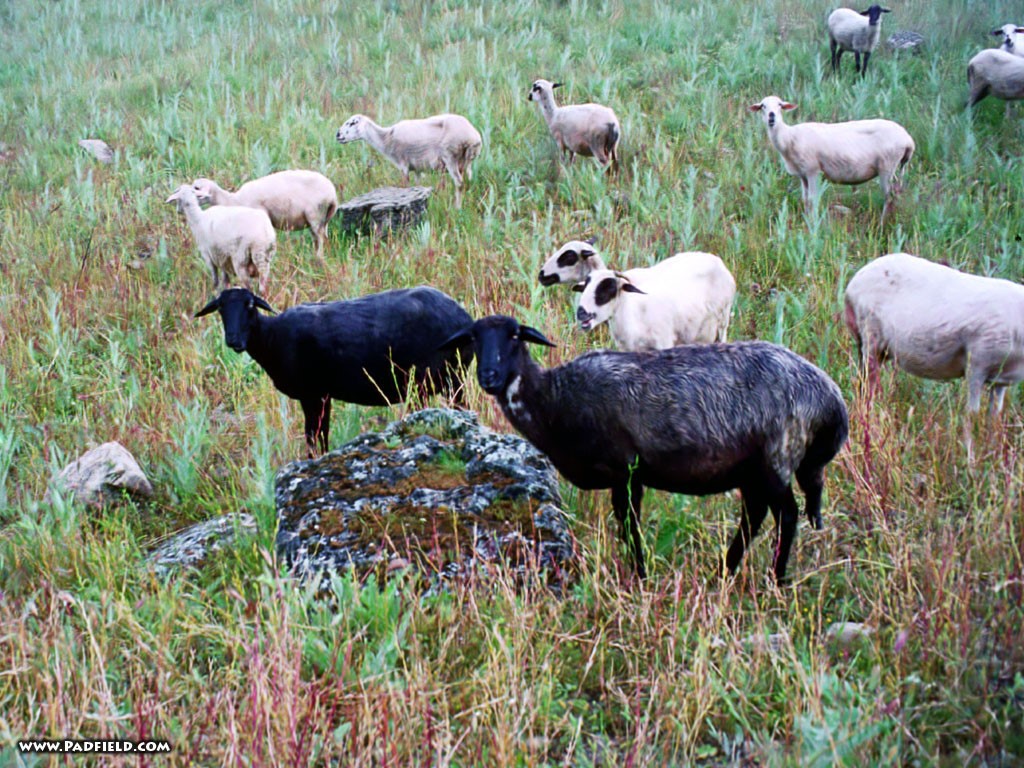
WHITE GARMENTS: Laodicea was known not only for its hot and cold waters, but also for its making of black glossy wool garments, made from black sheep, which sold for a rich price. But more valuable than earthly clothes of black would be heavenly clothes of white, purchased by the rewards of faithful service here on earth. A rich faith produces clean garments and covers their nakedness. (Photo shows black sheep photographed at Laodicea).

EYESALVE: Laodicea was also known for its university of medicine treating eye problems with salve. Merchants and perhaps even member of the church sold ointments and herbs with a reputation of having great healing power, yet they had no ointment to restore a long-range vision to heaven. The church was spiritually blind, Christ said.

CHRIST’S LOVE: During all this rebuke and chastening is an almost hidden statement of affirmation of Christ’s love, “As many as I love, I rebuke and chasten.” Jesus had not given up on the Laodicean church. If the Laodiceans were not beyond hope, so neither is anyone who “hears what the Spirit of the Lord says to the churches.” Rebuke is sometimes translated as reprove and is often found in relation to the Scriptures (2 Timothy 3:16, 4:2).  Chasten is used with instruction of children, often by the loving discipline of a parent (Hebrews 12:6-7) and often leads to our redemption (1 Corinthians 11:32). To be zealous means to boil with fervor of spirit and hot passion. The call to repentance is a further evidence that Christ wants to be welcomed into the church.

THE DOOR: Look, Christ is at the door, knocking. The door earlier was one that was opened and closed by Christ, yet here it is up to the church to open. Could He not force Himself in? It is obvious Christ is not speaking of a literal door to a church building, but to the hearts of those who profess to be Christians. Christ opens the door to heaven and salvation, but sinners must also open the door to Christ. To sup or dine was to enjoy the last and final meal of the day, a time in which the people relaxed and enjoyed the company of a day’s end (see Luke 17:8 for the same word usage).

What is the call to the church? To hear the voice of Christ, be zealous with fervency of faith and to repent from self-delusion. The result will be a communion meal with Christ in our hearts, in our churches, and ultimately, a meal in heaven at the marriage supper of the Lamb (Revelation 19:9).