Sunday, June 1, 2014

Israel 2014 -- Ein Gedi; Day 8

JUDEAN DESERT- Begin the morning at EIN-GEDI where David hid from Saul and composed some of the Psalms. 
(Source: shalomisraeltours.com)

Ancient travelers who made their way along the shores of the Dead Sea would no doubt shake their heads when they saw it.

How could so much water stand in such a barren place—and none of it be drinkable?

Before the obliteration of Sodom and Gomorrah, the Jordan Valley looked like the “garden of the Lord” (Genesis 13:10). But afterwards, even the many springs that bubbled beside the Dead Sea tasted too salty to swallow. The plentiful waters gave nothing in the way of sustenance.

They only offered a spiritual prompt of the need to take God seriously.
Against this depressing backdrop of death and desperation flows the Ein Gedi.

Ein Gedi—A Spring for More than Goats

If you want to find where history took place, just look for the waterholes.

Ein Gedi means, “Spring of the Wild Goat,” and suggests that animals—not just people—depended upon its fresh and plentiful streams (1 Samuel 24:1-2).
  • Because Ein Gedi represented one of only two springs that offered fresh water west of the Dead Sea, every nomad, wanderer, and warrior stopped there as they passed.
  • The Bible records Ammonites, Edomites, Meunites, and Moabites—Judah’s neighbors east of the Jordan—gathering there before their attack on Jehoshaphat (2 Chronicles 20:1-2).
But Ein Gedi served as more than a popular pit stop for travelers.
With regional water so scant, the spring hosted numerous settlements throughout history—thousands of years of continuous habitation.
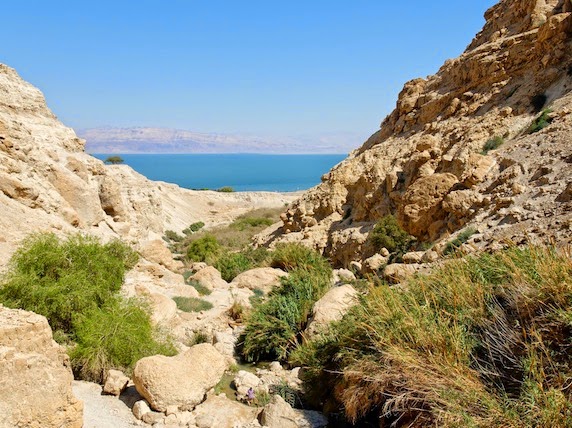
  • God allotted Ein Gedi to the tribe of Judah (Joshua 15:62), from which came David.
  • David’s familiarity with the oasis and its caves allowed him to select hiding places from the jealous King Saul (1 Samuel 23-24). David may have written Psalms 57 and 142 here, as the superscription for each psalm mentions David composing them in a cave.
  • The Hasmoneans made Ein Gedi their royal estate and administrative center in the 2nd-century BC.
  • Eusebius described Ein Gedi in his Onomasticon as being “a very large village of Jews.”
  • The area has a Canaanite temple as well as Roman forts, a Byzantine fort, and an Israelite fort—all situated to protect the nearby roadway.

Next we drive to MASADA, site of the Jew’s final stand against the Romans in AD 73, ascending by cable cars to see the remains of Herod’s palatial fortress and visit the Masada Museum.  

source: routestravel.com

Towering 1300 feet above the Dead Sea, Masada looks as intimidating today as it did to those who stood at its base thousands of years ago. This natural mesa looms tall across from the Lisan at the southern half of the Dead Sea.

Steep cliffs on all sides make the mountain look virtually impregnable. And it was.

Getting to the top has always come at a price. For modern visitors, that price amounts to a cable car ticket. But in antiquity, the price was a hard hike up the steep path Josephus labeled the “snake.”

In 1867, explorers rediscovered this pathway that lies along the eastern edge of Masada. For most folks, climbing the “Snake Path’’—the serpentine trail that snakes back and forth up the mountain—takes almost an hour. Going down is another story. I can testify that a person with a good set of shoes can run down the snake path in 12 minutes (especially if your group is about to leave you).

Masada Means “Stronghold”
After Rome made Herod the Great king, he came to the mesa in AD 37 to fortify it, erecting an eighteen-foot high wall around its perimeter.
  • His made winter palace there, and as was true with all of Herod’s fortresses, had every comfort and convenience he could manage.
  • The palace clung to the northern cliffs of Masada like a barnacle.
  • Covered staircases gave access to three levels of terraces and portions of his beautiful mosaics are still visible.
The Final Stand against Rome
After Rome destroyed Jerusalem’s temple in AD 70, a number of Jewish patriots took refuge in Masada.
  • Led by Eliezar Ben Yair, they stood firm against Rome for several years.
  • According to Josephus, on April 15, AD 73, the Romans crested the summit to discover that almost 1000 patriots had chosen to take their own lives rather than surrender their lives and families to the cruelty of Rome (Wars 7:394-397).
  • The western side of the mesa still shows the spine of Rome’s siege ramp—an earthen incline constructed to breach the defenses of the Jewish fortress.
Some historians give serious doubt to Josephus’ fantastic account, even though it offers our only history of the patriots’ demise. His story represents what we would want to believe occurred, whether it did or not.

Masada remains a symbol of Israel’s resolve even today. Many Israeli soldiers have stood atop the mountain and uttered the oath: “Masada shall not fall again.”


We then return early afternoon to the Isrotel Hotel for leisure time to enjoy the amenities of the hotel’s spa (optional), the immense swimming pool or experience floating in the DEAD SEA at the hotel’s private beach and a delicious evening buffet.

Thursday, May 22, 2014

Key Principle #15: Prayer (pt. 2)

     Why is prayer so vital to the church and to our lives? I believe we can see three reasons, with today's devotional being the first, based on Acts10:
    
     1. Prayer Empowers Us.
     Peter and Cornelius were both praying when God saw fit to empower both of them. He empowered Peter to see that indeed God shows no partiality. He was empowered to go beyond his prejudiced heart. Peter was changed by his vision and was prepared to see where God was leading him, but his vision only came because he was in prayer.
     We should pray, NOT primarily so to change the world or change the heart of God. Rather, we should pray because our hearts are desperately wicked and it’s me, it is me, it is me, O Lord, standing in the need of prayer.
     C.S. Lewis, author of the Chronicles of Narnia, said, “I pray because I can’t help myself. I pray because I’m helpless. I pray because the need flows out of me all the time-waking and sleeping. It doesn’t change God- it changes me."
     One of the biggest scandals I believe in the church today is not pornography, not adultery, not envy, but idolatry. Most Christians, myself included, do not follow after heavenly Father, but rather our own hedonistic feelings. Amen?
     Let me give you a test:
     If I were to tell you that tonight that Joel Olsteen or Dave Ramsey or Rick Warren or David Jeremiah were going to be at your church tonight...
     Would you go?
     In addition to one of those preachers being there, suppose that your pastor said he has been blessed by an anonymous donor who wanted to help the congregation get out of debt and your pastor was going to give out $1,000 to the first 250 people who came...
     Now, would you go?
     How many of you would pray about coming to church tonight? “Dear Lord, you know I am in debt. I want to ask you, is it Your will for me to come back tonight?” Most of you would not even think about praying about it and a large majority probably would go up to church as soon as you heard to make sure you were first in line.
     Would you feel “led to come”?
     Yet, most would never come to church if all they were doing is praying.
     My point is this: Most Christians are not led by the Spirit of God, but they are led by Christian preachers or greed or even by their personal feelings and all of those things which take the place of God are, simply and surely, idolatry.
    The number one reason we should pray is because our heart is desperately wicked and we need to pray as David did in Ps. 51: 10 “Create in me a clean heart, O God, and renew a steadfast spirit within me.”
      If a thousand dollars would bring you to church, but not the preached word, or a call to prayer, then we must really think what it is that motivates us to go.
   Peter had a hunger, a strong hunger, while he was praying. He could have stopped praying to meet his need, but he didn’t. The lusts of the flesh and the lust of the eyes and the boastful pride of life can get us to turn away from prayer but it can also get us when we are afflicted to turn to God in prayer.
     Look at James 5:13 “Is any one of you in trouble? He should pray. Is anyone happy? Let him sing songs of praise.” Verse 14 says our afflictions should prompt us to call others, the elders of the church, to pray. 

Saturday, May 17, 2014

Saturday: Blessed are the Peacemakers

The downloadable pdf is now available on www.fbckilleen.com or


From Purity to Peace; from seeing God to sons of God


What is a peacemaker? Is it only helping others to be reconciled with one another? If that is all, why would that alone result in us being called children of God? The word “peacemaker” is unique to this verse. The closest comparison in the New Testament is found in Col. 1:20 as it is applied to Christ.


18 And He is the head of the body, the church, who is the beginning, the firstborn from the dead, that in all things He may have the preeminence. 19 For it pleased the Father that in Him all the fullness should dwell, 20and by Him to reconcile all things to Himself, by Him, whether things on earth or things in heaven, having made peace through the blood of His cross.


Did you catch it? No, not the underlined words of making peace--the other part of the verses, with words like “firstborn” “reconcile” and “the Father.” Isn’t it amazing that the only two places in Scripture where peace-making is explained, it also relates to the family relationship?


Is there a connection? Jesus is not saying “Happy are those who help people get along with each other.” He is talking about making peace with our heavenly Father, and how that gets us to be called His children!


If you have all of the other beatitudes, that is great. But we must help others make peace with God! This is higher than only having our own purity of heart because it brings purity to others. It brings others to Christ, reconciling them and making “peace through the blood of the cross.”


Peace on earth is not lasting. Peace made with Christ is everlasting! “Peace I leave with you, My peace I give to you; not as the world gives do I give to you. Let not your heart be troubled, neither let it be afraid,” (John 14:27). He is not saying “Blessed are people who make peace like the world makes peace.” Jesus said there would never be lasting worldly peace, instead in the world we would have trouble. “These things I have spoken to you, that in Me you may have peace. In the world you will have tribulation; but be of good cheer, I have overcome the world,” (John 16:33).


Questions: Combine John 14:27 with John 14:1. What should keep our hearts from being troubled, afraid and essentially give us peace? In John 16:33, What did Jesus say he did to bring peace to believers?


Things that make for your peace


There is nothing that breaks the heart of Jesus more than when people fail to make peace with His heavenly Father. There is Biblical proof that this is true in Luke 19:41-44.


41 Now as He drew near, He saw the city and wept over it, 42 saying, “If you had known, even you, especially in this your day, the things that make for your peace! But now they are hidden from your eyes. 43For days will come upon you when your enemies will build an embankment around you, surround you and close you in on every side, 44 and level you, and your children within you, to the ground; and they will not leave in you one stone upon another, because you did not know the time of your visitation.”


Do you want to see an absence of worldly peace? Bring up the name of Jesus. Jesus spoke about worldly peace but not in a positive sense.


34 “Do not think that I came to bring peace on earth. I did not come to bring peace but a sword. 35 For I have come to 'set a man against his father, a daughter against her mother, and a daughter-in-law against her mother-in-law'; 36 and 'a man's enemies will be those of his own household.' 37 He who loves father or mother more than Me is not worthy of Me. And he who loves son or daughter more than Me is not worthy of Me. 38 And he who does not take his cross and follow after Me is not worthy of Me. 39 He who finds his life will lose it, and he who loses his life for My sake will find it. Matt. 10:34.39


Paul also made it abundantly clear that making peace means bringing people to salvation, reconciliation between God and man. And that results in us being called the children of God! Read Ephesians 2:


14 For He Himself is our peace, who has made both one, and has broken down the middle wall of separation, 15 having abolished in His flesh the enmity, that is, the law of commandments contained in ordinances,   so as to create in Himself one new man from the two, thus making peace,  16  and that He might reconcile them both to God in one body through the cross, thereby putting to death the enmity… 18 For through Him we both have access by one Spirit to the Father. 19 Now, therefore, you are no longer strangers and foreigners, but fellow citizens with the saints and members of the household of God…


Are you called a child of God?


What does it take to be a child of God? Clearly, it is by grace received through faith, “But as many as received Him, to them He gave the right to become children of God, to those who believe in His name, who were born, not of blood, nor of the will of the flesh, nor of the will of man, but of God,” (John 1:12-13).


But what does it take to be called the children of God? To be called a child of God is when others see you as a “chip off the old block.” We are called children of God because we are doing what the Father is doing. It means we are acting like God and bringing peace between humanity and God. Read 1 John 1:1 “Behold what manner of love the Father has bestowed on us, that we should be called children of God! Therefore the world does not know us, because it did not know Him.”


We are called children of God because we follow Him, in faith and then in obedience. We are never more like Christ than when we reconcile the world to make peace with God.

Friday, May 16, 2014

Friday: Blessed are the Pure in Heart

Climbing from mercy to purity

The climbing of the stairs of the beatitudes is not only stepping up for the requirements of the “blesseds” but also for the rewards. What that means is not only is it a greater challenge to seek to be pure in heart (5:8) than it is to be merciful (5:7), but the rewards also increase. We are comforted, but even better we shall inherit the earth. Better yet, we shall be filled with the righteousness of Christ by faith. Greater still, we shall receive mercy because even the righteous still need mercy. But what could be greater than that? Seeing God!

In the Old Testament, seeing God was a thing to be feared, because “no man can see God and live” (Exod. 33:20). Yet several did see God, including Moses, Isaiah, and Job said he knew that he would see God (Job 19:26, which also supports the resurrection). Seeing God was feared, yet an honor without parallel.  

Who has a pure heart?

“Well you know my heart,” some will say. Oh no I don’t! Jer. 17:9 says, “The heart is deceitful above all things, and desperately wicked: who can know it?” Only God knows all the hearts of humanity (1 King. 8:39).

The first mention of the word heart was in Gen. 6:5, “And God saw that the wickedness of man was great in the earth, and that every imagination of the thoughts of his heart was only evil continually.” It is described as “uncircumcised, hardened, wicked, godless, defiling the whole man, resisting the repeated will of God.”

But Ezekiel promised a wonderful heart surgery in Ezek. 11:19 and 36:26, “A new heart also will I give you, and a new spirit will I put within you: and I will take away the stony heart out of your flesh, and I will give you an heart of flesh.” The Psalmist said that God can create in us a clean heart (Ps. 51:10).

In the New Testament, we see that it is with the heart man believes and it results in righteousness (Rom. 10:9-10). And it is only through that faith are our hearts purified, “So God, who knows the heart,…(gave) them the Holy Spirit, just as He did to us, and made no distinction between us and them, purifying their hearts by faith” (Acts 15:8-9).

Once we are saved, then we can pursue “righteousness, faith, love, peace with those who call on the Lord out of a pure heart.” It is only after we are saved can we truly love as it says in 1 Peter 1:22 “Since you have purified your souls in obeying the truth through the Spirit in sincere love of the brethren, love one another fervently with a pure heart.”

Turn to James 4:7-10 and see how closely the brother of our Lord is recalling the beatitudes.

7 Therefore submit to God. Resist the devil and he will flee from you. 8 Draw near to God and He will draw near to you. Cleanse your hands, you sinners; and purify your hearts, you double-minded. 9Lament and mourn and weep! Let your laughter be turned to mourning and your joy to gloom. 10Humble yourselves in the sight of the Lord, and He will lift you up.
Old Testament parallel

Psalm 24 was undoubtedly in the Lord’s mind when he said this beatitude. It reads, “The earth is the Lord's, and all its fullness, The world and those who dwell therein. 2 For He has founded it upon the seas, And established it upon the waters. 3 Who may ascend into the hill of the Lord? Or who may stand in His holy place? 4 He who has clean hands and a pure heart, Who has not lifted up his soul to an idol, Nor sworn deceitfully. 5 He shall receive blessing from the Lord, And righteousness from the God of his salvation. 6 This is Jacob, the generation of those who seek Him, Who seek Your face.”
Pure hearts want to see God

Do you truly want to see God. In discussing whether or not God was in a sense bribing His children to be good by offering them rewards, C.S. Lewis said, “We are afraid that heaven is a bribe, and that if we make it our goal we shall no longer be disinterested. It is not so. Heaven offers nothing that a mercenary soul can desire. It is safe to tell the pure in heart that they shall see God, for only the pure in heart want to.” (The Problem with Pain)

Some people don’t really want to go to heaven and they definitely would not want to see God in this lifetime. They may say they do but it is because they do not truly see their sinfulness. It is like the illustration of a mechanic who goes to work.

“Each day, the mechanic starts clean. Throughout the day, he becomes dirty; but he does not feel overly dirty because he has been like that for days on end. When he looks at himself, he thinks he is relatively clean. He started clean in the morning, and he cannot see how filthy he has become during the day.

“Imagine, however, if right after work, the mechanic went to a wedding. He tried to embrace the bride, who was wearing a pure white dress. All of the sudden, he realized that he was filthy. The purity of the white dress caused the mechanic to see his own impurity. So it is with the purity of the heart.

“The more we see the purity of Christ, the more we see our own filthiness. When we see the heavenly Bridegroom dressed in white, we see the blessedness and purity of the robe of Christ’s righteousness. The more we see the purity of Christ, the more we see the uncleanness and impurities of our own soul.” (Daily Devotional, gospelchapel.com)

A filthy person doesn’t want to be near a clean person once he realizes his filthiness. On the other hand a pure person’s greatest reward is to see the ultimate in purity of heart, the God who created us. 

Question: Do you truly want to see God?

Some people don’t really want to go to heaven and they definitely would not want to see God in this lifetime. They may say they do but it is because they do not truly see their sinfulness. A pure person’s greatest reward is to see the ultimate in purity of heart, the God who created us.


Question: If you don’t want to go to church, don’t want to read the Bible, don’t want to hear sermons, don’t want to give, but want to live like the world does, ask yourself this, “Do I really want to see God?”

What keeps us from seeing God?

Hebrews 12:14 speaks on seeing God, “Pursue peace with all men and the sanctification without which no one will see the Lord.”

A filthy person doesn’t want to be near a clean person once he realizes his filthiness.  

Question: Think of a time when you were absolutely filthy. What did you want to do and did you want to be in a perfectly clean room? 

Wednesday, May 14, 2014

Thursday: Blessed are the merciful


A politician went to have his portrait done and upon seeing the results was quite upset about how his pictures had turned out. He went in and griped at the photographer and said, “These pictures do not do me justice!” “Justice?” the photographer said, “with a face like yours, you do not need justice; you need mercy.”

Question: What is justice? What is mercy?

How mercy builds upon righteousness
   Previously we studied the righteousness of God, of Christ and of humans. Longing for righteousness must be followed by mercy. A poor spirit (5:3) leads to mourning (5:4) which leads to humility (5:5), followed by a desire for righteousness (5:6). We have no righteousness apart from faith.

In light of that, how can we have anything except for a merciful heart? The word for can be translated because. The verse could read, “Merciful people are happy, because they too shall obtain mercy.” They do not carry grudges or keep a score of debts. They dispense mercy, knowing that they have and shall receive mercy themselves, and are happier for it.

We sometimes think mercy is the opposite of justice, but actually it is a complement to it. When we see justice, we see the need for mercy. A mother of a man accused of a serious crime went to Napoleon and pled for mercy. “Mercy for that scoundrel? He doesn’t deserve it!” was Napoleon’s reply. The mother said, “Sir, it wouldn’t be mercy if he deserved it!” The mother's logic prompted Napoleon to relent, “Well, then, I will have mercy.”

Some people use this and other verses on forgiveness to say that God’s mercy on us depends on our mercy towards others. Such thinking is contradictory to what the word mercy means…we shall obtain mercy because of our sins, not because of our good works.

Question: What is the opposite of being a merciful person?
Mercy for the miserable

The Greek word for merciful and mercy is based on eleos which is a descriptive adjective and is not based on emotions. In other words, God doesn’t feel sorry for us, but rather He is a merciful in His nature. The Latin word is miserecordia which sounds a lot like our word, miserable. In fact, the King James translates a Greek word similar to eleos to miserable twice. “If in this life only we have hope in Christ, we are of all men most miserable” (1 Cor. 15:19)

“Because thou sayest, I am rich, and increased with goods, and have need of nothing; and knowest not that thou art wretched, and miserable, and poor, and blind, and naked” (Rev. 3:17). A person who needs mercy is miserable and a person who refuses to give it will eventually become miserable.

Read Romans 9:16 “So then it is not of him that willeth, nor of him that runneth, but of God that sheweth mercy.” Titus 3:5 “Not by works of righteousness which we have done, but according to his mercy he saved us, by the washing of regeneration, and renewing of the Holy Ghost;” Luke 6:36 “Be ye therefore merciful, as your Father also is merciful.”

Now read Matthew 6:12,14-15 “And forgive us our debts, as we forgive our debtors. …For if ye forgive men their trespasses, your heavenly Father will also forgive you: But if ye forgive not men their trespasses, neither will your Father forgive your trespasses.”

Questions: Who is it that initiates mercy, God or us? Do we have to do anything to deserve mercy? What do others have to do in order for us to be merciful?

Being merciful is a Be-Attitude

What is your attitude towards others who are miserable and pitiable? The worse someone is, the more they need mercy. In God’s eyes, how someone acts towards us is not what’s most important, but rather how we react. The word merciful is not a noun, but rather an adjective. It describes who the believer is, and not just what he does.

Questions: When you are wronged, do you seek justice or mercy? Now, when you are wrong, do you seek justice or mercy?

When and how do we obtain mercy?

If we are merciful, we may notice that others are merciful toward us and we will see God’s mercy come to us like a reflection in a mirror. It is more than just receiving mercy in heaven, but we shall obtain mercy here as well. So how can we go beyond our hurts and get to healing?  

      Don’ts and do’s                                              Do’s and don’ts

1) Don’t nurse, burn                                   1) Immerse, don’t churn
   (Job 11:16, Acts 19:19)                                 (Mic. 7:19, Prov. 30:33)
 

2) Don’t rehearse, spurn                           2) Reverse, don’t yearn
   (Heb. 8:12, 10:17)                                         (Isa. 61:3, Ex. 14:12)
 

3) Don’t curse, learn                                  3) Verse, don’t turn
   (Prov. 9:9, 2 Cor. 1:4)                                 (Ps. 119:10-11)


Wednesday: Hunger and Thirst for Righteousness

The downloadable pdf is now available on www.fbckilleen.com or


Righteousness builds upon meekness
After meekness, there is a thirst and hunger for righteousness. Righteousness is not merely doing right and avoiding wrong. That is legalism. Without meekness, such a desire would only result in self-righteousness. Righteousness is right standing before God brought about by the righteousness of God and results in a continued path to blessed happiness.

The Righteousness of God
God’s righteousness is explained in Phil. 3:9. “And be found in him, not having a righteousness of my own that comes from the law, but that which is through faith in Christ--the righteousness that comes from God on the basis of faith.” Paul was righteous by the Law, but when judged by God, Paul’s righteousness fell short of God’s perfection.

We are to yearn not for our righteousness, but for God’s righteousness. Romans 1:17 says that the God’s righteousness is revealed by faith.

God’s rule says that sacrificial blood brings about forgiveness of sin. “For the life of the flesh is in the blood, and I have given it to you upon the altar to make atonement for your souls; for it is the blood that makes atonement for the soul” (Leviticus 17:11). Blood on the altar will make atonement for the soul. But not the blood of animals. Psalms 40:6 says, “Sacrifice and offering You did not desire; My ears You have opened. Burnt offering and sin offering You did not require.” Hebrews 10:4 says, “For it is impossible for the blood of bulls and goats to take away sins.”         

So whose blood? The blood of Christ. Hebrews 9:12 says, “Not with the blood of goats and calves, but with His own blood He entered the Most Holy Place once for all, having obtained eternal redemption.”

So how can we know that God will keep His promise, to forgive us of our sins? By trusting that God is righteous. This is said again in Rom. 3:21-22a, “21 But now the righteousness of God apart from the law is revealed, being witnessed by the Law and the Prophets, 22 even the righteousness of God, through faith in Jesus Christ, to all and on all who believe.”

The famous line of Rom. 3:23 is actually a dependent clause of a sentence explaining God’s righteousness is shown by faith:

We are made right in God's sight when we trust in Jesus Christ to take away our sins. And we all can be saved in this same way, no matter who we are or what we have done. For all have sinned; all fall short of God's glorious standard. Yet now God in his gracious kindness declares us not guilty. He has done this through Christ Jesus, who has freed us by taking away our sins. (New Living Translation)

We are saved because God is righteous. We hunger and thirst for God’s righteousness and to do otherwise is ignorant. Romans 10 says, “3 For they being ignorant of God's righteousness, and seeking to establish their own righteousness, have not submitted to the righteousness of God. 4 For Christ is the end of the law for righteousness to everyone who believes.”

Questions: Do you feel smug about how good you are compared to others? Are you looking at others’ sins rather than God’s righteousness?

The Righteousness of Christ
Jesus was the only one who was righteous in God’s sight. 2 Cor. 5:21 says Christ’s sacrifice made us righteous, even though we aren’t. “For God made Christ, who never sinned, to be the offering for our sin, so that we could be made right with God through Christ.” 1 Peter 3 also explains that Jesus, the just, died for us, the unjust, “18 Christ also suffered when he died for our sins once for all time. He never sinned, but he died for sinners that he might bring us safely home to God. He suffered physical death, but he was raised to life in the Spirit.” (NLT)

Only Christ fulfills the righteous requirements of the Law; only His blood on the altar is pure. Romans 8 says, “3 For what the law could not do, in that it was weak through the flesh, God sending his own Son in the likeness of sinful flesh, and for sin, condemned sin in the flesh: 4 That the righteousness of the law might be fulfilled in us, who walk not after the flesh, but after the Spirit.”

Question: How are you affected by the “great exchange” of Christ becoming sin, even though He had none, so that we could have His righteousness, even though we have none?

The Righteousness of Man
After we hunger and thirst for God’s righteousness and when we know that we are only righteous in Christ, then we can truly long for our righteousness. But unlike a longing for food to satisfy ourselves, we should long to bear fruit. 2 Cor. 9 says:

10” Now may He who supplies seed to the sower, and bread for food, supply and multiply the seed you have sown and increase the fruits of your righteousness, 11 while you are enriched in everything for all liberality, which causes thanksgiving through us to God.”

After we are saved, we bear righteous fruit, as James 3:18 says, “And the fruit of righteousness is sown in peace of them that make peace.” Paul said in Eph 5:9, “For the fruit of the Spirit is in all goodness and righteousness and truth.” and again in Phil. 1:11 “being filled with the fruits of righteousness which are by Jesus Christ, to the glory and praise of God.”
They shall be satisfied 
There is a verse that says “do not become weary in doing good for at the proper time we will reap a harvest if we do not give up” (Gal. 6:9, NIV). If you are not feeling satisfied or filled in all you are doing, it may be because you are looking at the wrong things. Self-righteousness comes in comparison to others. Satisfying-righteousness looks to the harvest.

Question: What type of fruit do you bear? Are you doing good but with the wrong attitude? If you long for righteousness and are not filled, whose righteousness are you hungering and thirsting for?